
Category: Quick Guide / Transportation
⚡ Understanding Dashboard Warning Lights
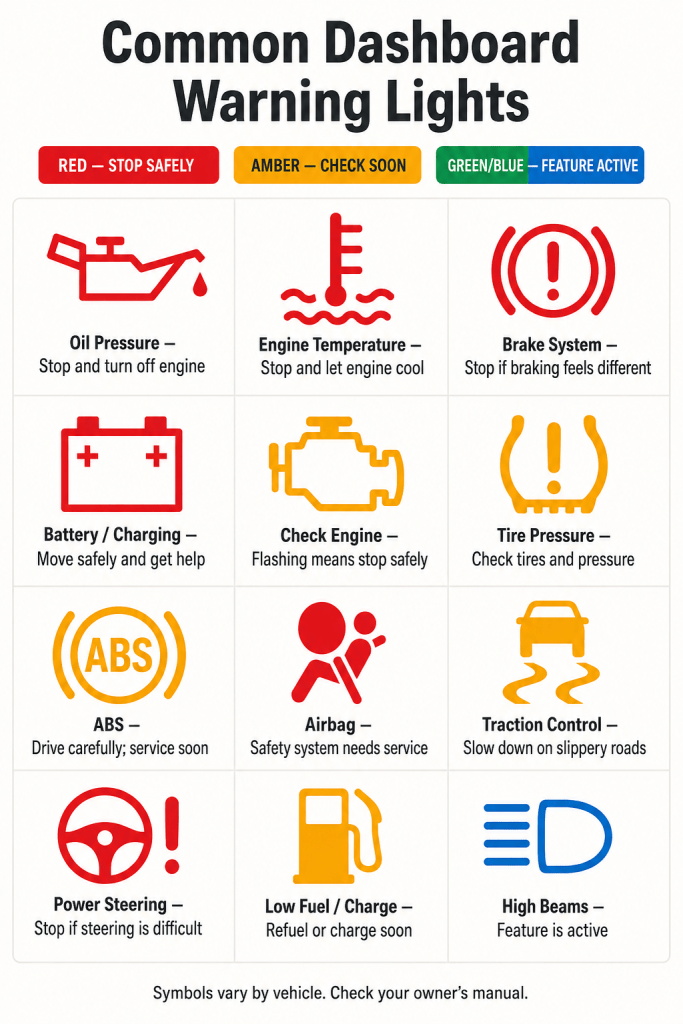
A dashboard warning light means the vehicle has detected something you should know about. Some lights are simple reminders. Others mean you should stop driving as soon as it is safe.
The exact symbol and meaning can vary by vehicle. Check the owner’s manual when you are unsure.
First: Look at the Color
Dashboard colors usually provide a general level of urgency.
Red
A red warning often means:
- Stop as soon as it is safe.
- A serious problem may be present.
- Continuing to drive could be dangerous or damage the vehicle.
Examples include:
- Oil-pressure warning
- Engine-temperature warning
- Brake-system warning
- Charging-system warning
Yellow or Amber
A yellow or amber light usually means:
- The vehicle needs attention.
- You may be able to continue carefully.
- The problem should be checked soon.
Examples include:
- Check-engine light
- Low tire pressure
- Antilock-brake warning
- Airbag warning
- Traction-control warning
Green, Blue, or White
These lights usually show that a feature is operating.
Examples include:
- Headlights
- High beams
- Turn signals
- Cruise control
- Driver-assistance features
These are generally indicators rather than warnings, but you should still understand what they mean.
If a Warning Light Appears While Driving
- Remain calm.
- Keep both hands on the steering wheel.
- Notice the color and symbol.
- Check whether the vehicle feels, sounds, or smells different.
- Reduce speed if necessary.
- Move to a safe location before checking the manual or your phone.
- Stop the engine if the light indicates an immediate danger.
- Call roadside assistance if the vehicle may be unsafe.
Do not search for the symbol on your phone while driving.
Stop Driving Immediately if You Notice
Pull over as soon as it is safe if:
- A red oil-pressure light appears.
- The temperature warning appears.
- The brake warning remains on and braking feels different.
- The vehicle loses power.
- Steering becomes difficult.
- The engine is shaking severely.
- The check-engine light is flashing.
- Smoke or steam appears.
- You smell fuel or something burning.
- Several warning lights appear and the vehicle behaves abnormally.
Turn on the hazard lights and call for assistance.
Oil-Pressure Warning
This symbol often looks like an oil can.
If it stays on while the engine is running:
- Pull over safely.
- Turn off the engine.
- Do not continue driving.
- Check the owner’s manual.
- Call roadside assistance or a repair professional.
The light does not simply mean that an oil change is due. It may mean the engine is not receiving enough oil pressure. Continuing to drive could cause major engine damage.
Engine-Temperature Warning
This symbol may look like a thermometer over waves.
If it appears:
- Turn off the air conditioning.
- Move to a safe place.
- Turn off the engine.
- Stay away from steam.
- Allow the vehicle to cool.
- Call for assistance.
Never remove a hot radiator or coolant cap. Hot, pressurized coolant can cause serious burns.
Brake-System Warning
This symbol may show an exclamation point, the word “BRAKE,” or a circle between parentheses.
First, check whether the parking brake is fully released.
If the light remains on:
- Pay attention to how the brake pedal feels.
- Pull over safely if braking feels different.
- Do not continue driving if the pedal feels soft, braking power is reduced, or another brake warning appears.
- Call for professional assistance.
Low brake fluid or another brake-system problem may require immediate attention.
Battery or Charging-System Warning
This symbol usually looks like a battery.
It often means the charging system is not supplying power correctly. The vehicle may continue running briefly using stored battery power.
If it appears:
- Turn off unnecessary electrical equipment.
- Move to a safe location.
- Avoid shutting off the engine until safely stopped.
- Call roadside assistance.
- Do not assume that replacing the battery will solve the problem.
The alternator, wiring, drive belt, or another charging component may be involved.
Check-Engine Light
This symbol often looks like an engine.
If It Is Steady
A steady light usually means the vehicle should be checked soon.
- Make sure the fuel cap is secure if your vehicle has one.
- Notice whether the vehicle is running normally.
- Schedule diagnostic service.
- Avoid ignoring the light for an extended period.
If It Is Flashing
A flashing check-engine light may indicate a problem that can quickly damage the engine or emissions system.
- Reduce speed.
- Avoid hard acceleration.
- Pull over safely.
- Turn off the engine if it is shaking or losing power.
- Call roadside assistance or a repair professional.
Tire-Pressure Warning
This symbol often looks like a tire with an exclamation point.
If it appears:
- Reduce speed.
- Avoid sudden turns and braking.
- Move somewhere safe.
- Look for a visibly flat or damaged tire.
- Check tire pressure when the tires are cool.
- Inflate tires to the pressure listed on the vehicle’s door label or in the owner’s manual.
Do not use the maximum pressure printed on the tire as your normal target unless the vehicle manufacturer specifically instructs you to.
If a tire is losing air quickly or is visibly damaged, do not continue driving.
Antilock-Brake Warning
This light usually shows the letters “ABS.”
The regular brakes may still work, but the antilock feature may not.
- Drive cautiously.
- Leave extra stopping distance.
- Avoid sudden braking when possible.
- Arrange service promptly.
If the ABS light appears with a red brake warning or braking feels abnormal, stop driving and call for assistance.
Airbag Warning
This light may show a seated person with a circle in front.
It may mean that an airbag or seat-belt pretensioner will not work correctly during a crash.
The vehicle may still drive normally, but an important safety system may be unavailable. Arrange service as soon as possible.
Do not attempt to repair an airbag system yourself.
Traction-Control or Stability-Control Light
This symbol often looks like a vehicle with wavy lines behind it.
If It Flashes Briefly
The system may be helping the vehicle maintain traction. Reduce speed and drive smoothly.
If It Stays On
The system may be turned off or have a problem.
- Check whether the feature was accidentally disabled.
- Drive cautiously, especially in rain, snow, or ice.
- Arrange service if the light remains on.
Low-Fuel or Low-Charge Warning
A fuel-pump symbol usually indicates low fuel. An electric vehicle may display a battery symbol or low-range warning.
- Find a safe fueling or charging location.
- Avoid waiting until the vehicle stops.
- Confirm the correct fuel or charger type.
- Do not take an unfamiliar or unsafe shortcut to reach a station.
If the available range becomes critically low, move toward a safe stopping location and contact roadside assistance.
Power-Steering Warning
This light may show a steering wheel with an exclamation point.
Steering may become much harder.
- Hold the wheel firmly.
- Reduce speed.
- Avoid sudden turns.
- Move to a safe location.
- Turn off the vehicle only after you are safely stopped.
- Call for assistance if steering remains difficult.
Electric or Hybrid Vehicle Warning
Electric and hybrid vehicles may show warnings for:
- High-voltage battery
- Electric-drive system
- Charging system
- Reduced power
- Battery temperature
- Hybrid system malfunction
Follow the message on the dashboard and check the owner’s manual.
Do not touch exposed high-voltage cables or attempt to repair the battery system. Stop driving and call for professional assistance if the vehicle reports a serious electrical-system warning or loses power.
If Several Lights Appear at Once
Several warning lights may appear because of:
- Charging-system failure
- Electrical problem
- Engine shutdown
- Sensor or computer problem
- Low battery voltage
- Serious vehicle malfunction
Pay attention to how the vehicle behaves.
If steering, braking, engine power, or visibility is affected:
- Turn on the hazard lights.
- Move away from traffic.
- Stop the vehicle.
- Call roadside assistance.
Some Lights Are Normal at Startup
Many dashboard lights turn on briefly when you start the vehicle. This allows the vehicle to check its systems.
Most should turn off after the engine starts.
A light may require attention if it:
- Does not turn off
- Appears while driving
- Flashes repeatedly
- Returns after being cleared
- Appears with an unusual sound, smell, or change in performance
What to Tell a Mechanic
Record:
- Symbol or warning message
- Color of the light
- Whether it was steady or flashing
- When it appeared
- How long it remained on
- Any unusual sound, smell, or vibration
- Whether the vehicle lost power
- Recent repairs or maintenance
Take a photograph of the dashboard after you have stopped safely.
Do not erase a warning code or disconnect the battery simply to make the light disappear. That can remove information needed to diagnose the problem.
Quick Warning-Light Checklist
- Notice the color and symbol.
- Check whether the vehicle feels or sounds different.
- Move somewhere safe before checking the manual.
- Stop for a red or flashing warning.
- Turn off the engine for oil-pressure or overheating warnings.
- Do not continue if steering or braking is affected.
- Photograph the warning after stopping.
- Check the owner’s manual.
- Call roadside assistance when the vehicle may be unsafe.
- Arrange service for warnings that remain on.
Related Guides
- Understanding Dashboard Warning Lights
- What to Do When Your Vehicle Breaks Down
- Basic Vehicle Maintenance & Service Appointments
- Building a Vehicle Emergency Kit
- Safe Driving Habits for Everyday Travel
- Driving Safely in Rain, Snow & Poor Weather
- Buying Gas & Charging an Electric Vehicle
- Solving a Problem Step by Step
- Talking With Customer Service

